How Do Implant Dentists Attract $20K+ Cases Without Chasing Leads?
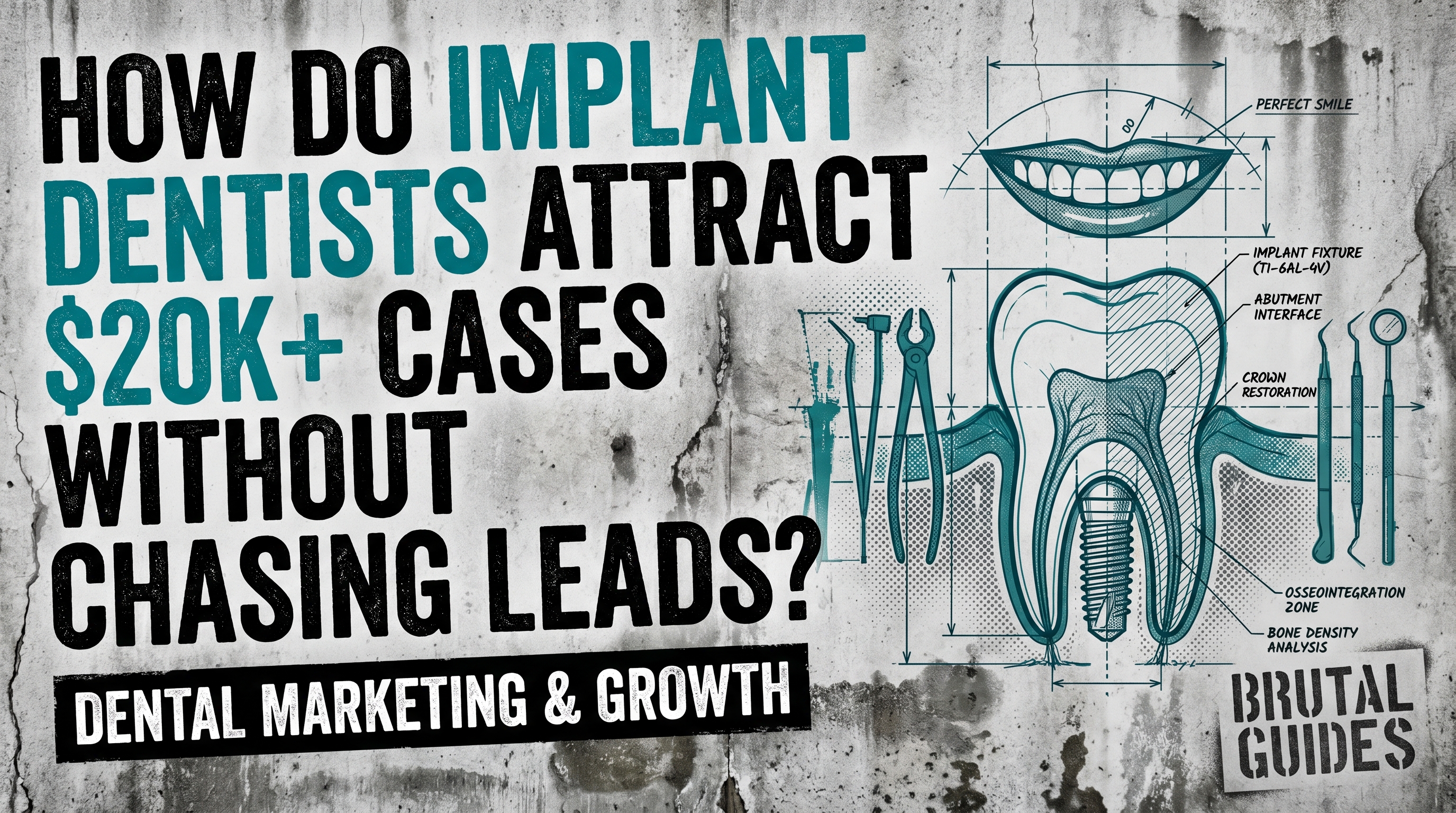
Most dental implant practices market the same way: run Google Ads, bid on "dental implants near me," and hope the phone rings. The problem isn't the ads. It's who they attract. Implant dentists who consistently close $20K+ cases don't chase leads through ad auctions. They use a book funnel to attract patients who've already decided to invest in quality, not price-shop five practices for the cheapest quote. A Brutally Honest Guide™ tailored to implant patients does the heavy lifting: it builds trust and pre-qualifies prospects during the 3-6 months they spend researching before choosing a provider, according to American Dental Association research. Our dental clients using this approach consistently tell us the consultations themselves run differently because the patient shows up informed.
The Problem with Standard Dental Implant Marketing
The typical implant marketing playbook looks like this: spend $3,000-$10,000/month on Google Ads, send clicks to a landing page offering a "free consultation," and wait. Some of those clicks turn into calls. Most of those calls are people asking one question: "How much do implants cost?"
That's a price shopper. They're calling you and four other practices. They'll pick whoever quotes lowest or offers the biggest financing deal. You just paid $200-$500 to acquire that call, based on typical dental advertising benchmarks, and you're competing on price for a procedure where price shouldn't be the deciding factor.
The math gets worse. Cost-per-click for "dental implants" runs $5-$15 in most markets, higher in competitive metros. A practice spending $5,000/month on ads might generate 20-30 leads. Of those, maybe 5-8 schedule a consult. Of those, maybe 2-3 accept treatment. That's $1,500-$2,500 per acquired patient before you've done any clinical work.
It works, sort of. But it's a treadmill. The moment you stop spending, the leads stop. And the leads you do get aren't pre-sold on you. They're comparing.
How a Book Changes the Patient Acquisition Dynamic
A book funnel replaces the "free consultation" offer with something that does actual work before the patient ever contacts you.
Instead of bidding for attention, you offer a free copy of your book. Something like "A Brutally Honest Guide™ to Dental Implants" or "A Brutally Honest Guide™ to Replacing Missing Teeth." The patient requests it through a landing page, reads it over a few days, and by the time they call your office, the conversation has shifted completely.
They're not asking "How much?" They're saying "I read your book. I think I'm a candidate. When can I come in?"
That shift happens because the book handles three things your ads can't.
Education at the patient's pace. A 30-chapter, 206-page book covers what implants are, how the process works, what recovery looks like, what questions to ask, and what red flags to watch for. The patient absorbs this on their own timeline, not in a rushed 15-minute consult where they're too nervous to ask real questions.
Trust before the first appointment. When someone reads your honest take on implant costs and your explanation of why the cheapest option often isn't the best, they trust you before walking through the door. You're not pitching. You're confirming fit.
Natural filtering. Price shoppers don't read 206-page books. The patients who request the book, actually read it, and then call are the ones willing to invest in the right provider. Your consult calendar fills with better-fit patients, not more patients.
Want the full breakdown of how a book funnel works? That post covers the 5-phase process.
What This Looks Like for a $25K Full-Arch Case
A full-arch restoration patient isn't making a casual decision. They're looking at $20,000-$50,000+, multiple appointments, and months of commitment. These patients research obsessively. They read reviews, watch YouTube videos, join Facebook groups, and compare practices for weeks or months.
In that research window, your book can be the thing that ends their search. We see this consistently with dental clients: the patient who reads the book and calls isn't comparing you to three other practices. They've already chosen you. The consult becomes a treatment planning session, not a sales pitch.
One full-arch case covers your entire book funnel investment for the year. A Title license is $4,800/year (after a one-time $3,000 Title Claim). A complete funnel with landing page and automated follow-up is $850/month. When a single case is worth $25,000+, the ROI question answers itself.
And the referral loop compounds it. General dentists who refer implant cases love having a book to hand patients. It makes their referral feel thoughtful, not transactional. Patients who have a great experience hand copies to friends and family. Each book becomes a referral tool that keeps working without additional ad spend.
The Brutally Honest Part
A book funnel won't fix a broken practice. If your clinical outcomes don't match the expertise in your book, patients will notice. The book sets expectations. You have to meet them.
This also isn't a volume play. If your practice model depends on doing 50 discount implant cases per month, a book funnel isn't the right tool. It's built for practices that want fewer, higher-value cases with better-fit patients. Quality over quantity.
And timing matters. A book funnel works on the research-phase patient, the person spending 3-6 months deciding. It doesn't capture the emergency "I broke my tooth last night" call. You still need other channels for that. The book funnel is the long game that compounds over time, not a same-day lead machine.
If your practice focuses on high-value dental procedures and you're tired of competing on price, this is the model worth investigating.
Frequently Asked Questions
How is this different from running Google Ads for dental implants?
Google Ads put you in a bidding war for clicks from people who may or may not be ready to commit. A book funnel attracts patients during their research phase and builds trust before they ever contact you. The leads cost less per acquisition and convert at higher rates because they arrive pre-educated, not price-shopping.
What kind of dental implant book works best?
The most effective titles address the patient's biggest fear or question directly. Titles like "A Brutally Honest Guide™ to Dental Implants" or "A Brutally Honest Guide™ to Replacing Missing Teeth" work because they promise transparency. Each book is 30 chapters and 206 pages, built from your clinical expertise without you sitting at a keyboard for months.
Can I use the book alongside my existing marketing?
Yes, and you should. Add the book offer to your existing implant landing pages, share excerpts on social media, give copies to referring general dentists, and email your existing patient base. The book becomes the conversion tool across every channel, not a replacement for your other marketing. Do book funnels work for dentists? covers the full channel strategy.
How quickly will I see results?
The book itself takes 4-6 weeks to produce. After launch, most dental practices see their first book-sourced consultations within 30-60 days. The compounding effect, where referrals and organic discovery stack on top of your direct promotion, typically kicks in around month 3-4. This isn't overnight, but the patients who come through are worth the wait.
Sources
- American Dental Association, Health Policy Institute: patient research timelines for major dental procedures (3-6 month average)
- Dental industry benchmarks: cost-per-click ($5-$15) and patient acquisition costs ($200-$500+) for implant and cosmetic dentistry advertising
- Brutal Guides client data: treatment acceptance patterns for dental practice clients
If the ad treadmill is eating your implant marketing budget, see how dental practices use book funnels to attract higher-value cases. Or book a call and we'll run the math for your practice.
Want a Book Funnel That Actually Works?
Stop chasing leads. Let a Brutally Honest Guide™ bring qualified prospects straight to your calendar.